WE’RE VOTING UNION YES!
WHEN
Thursday, September 26, 2024
10 am – 2 pm & 3 pm – 7 pm
WHERE
The Patricia and Robert Levinson Student Center (1st Floor in the Annenberg building), 1468 Madison Avenue, New York, NY
Employees are free to vote at any time the polls are open.
On Thursday, September 26 we have a historic opportunity to establish a democratic voice, secure improvements in our working conditions, and create a more inclusive and accessible workplace by voting “yes” for SSW-UAW as our union.
After more than two years, including thousands of conversations and numerous town halls among student workers, we have a clear choice. With a union, the Sinai administration will have a legal obligation to negotiate with our elected representatives over pay, benefits, and workplace rights – and to secure any agreements on improvements or maintaining current benefits in a legally binding and enforceable contract. We will also be joining more than 100,000 other academic employees – including graduate employees, postdocs, research scientists, and adjunct faculty – who have already chosen to bargain collectively as part of UAW.
Right now, the Sinai administration unilaterally decides if, when, and how to address challenges faced by student workers. With collective bargaining, we can meet at the bargaining table as equals. With strong participation and support from the entire student worker community, we can bargain a union contract that better meets our needs.
In hundreds of conversations, and in town halls and other meetings, student workers have already identified some of the common priorities that we could address through a contract. Consider the thoughts of our colleagues and these basic reasons to vote “union yes” on Thursday, September 26.
Continuing to build a movement at Sinai and across academia
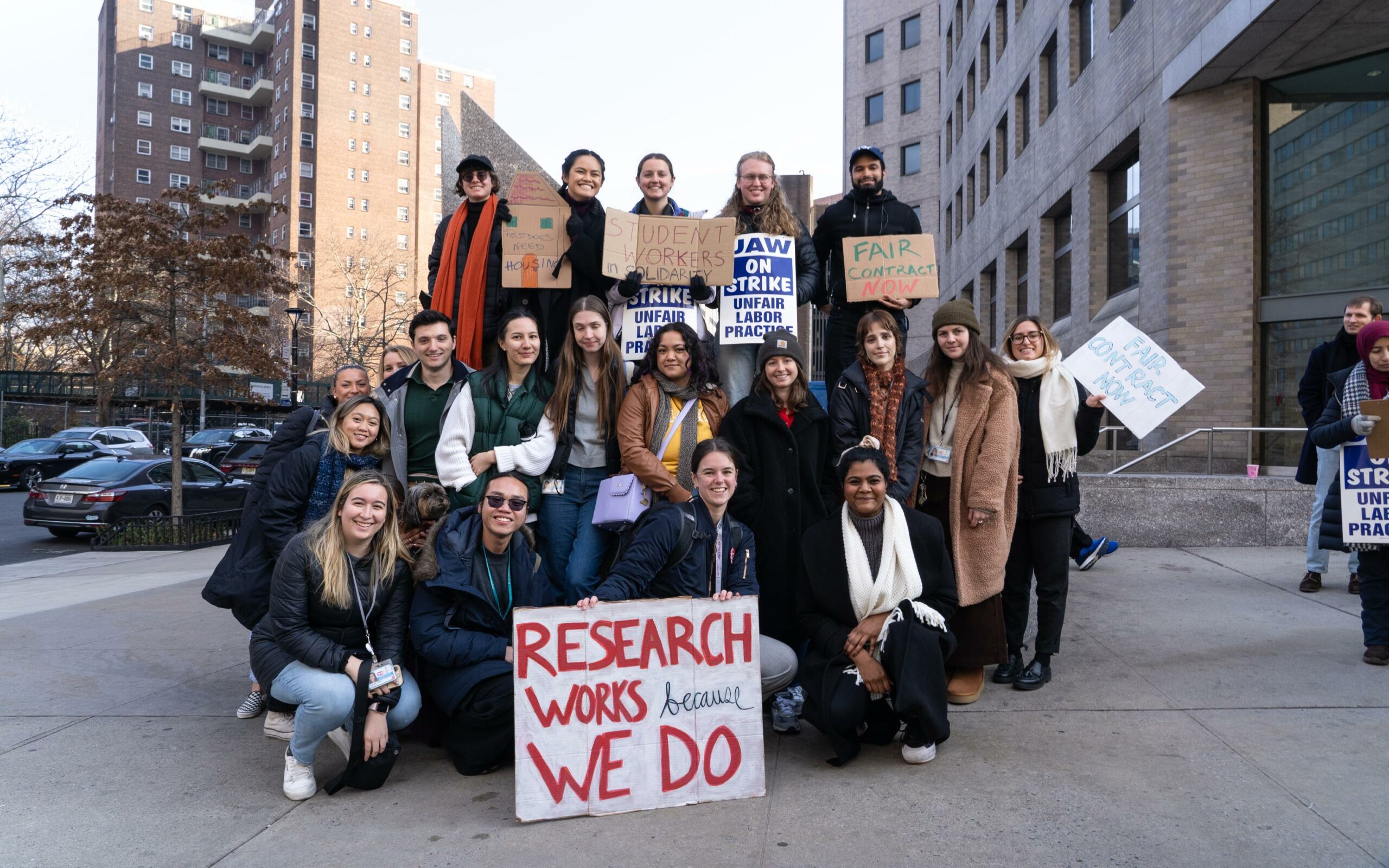
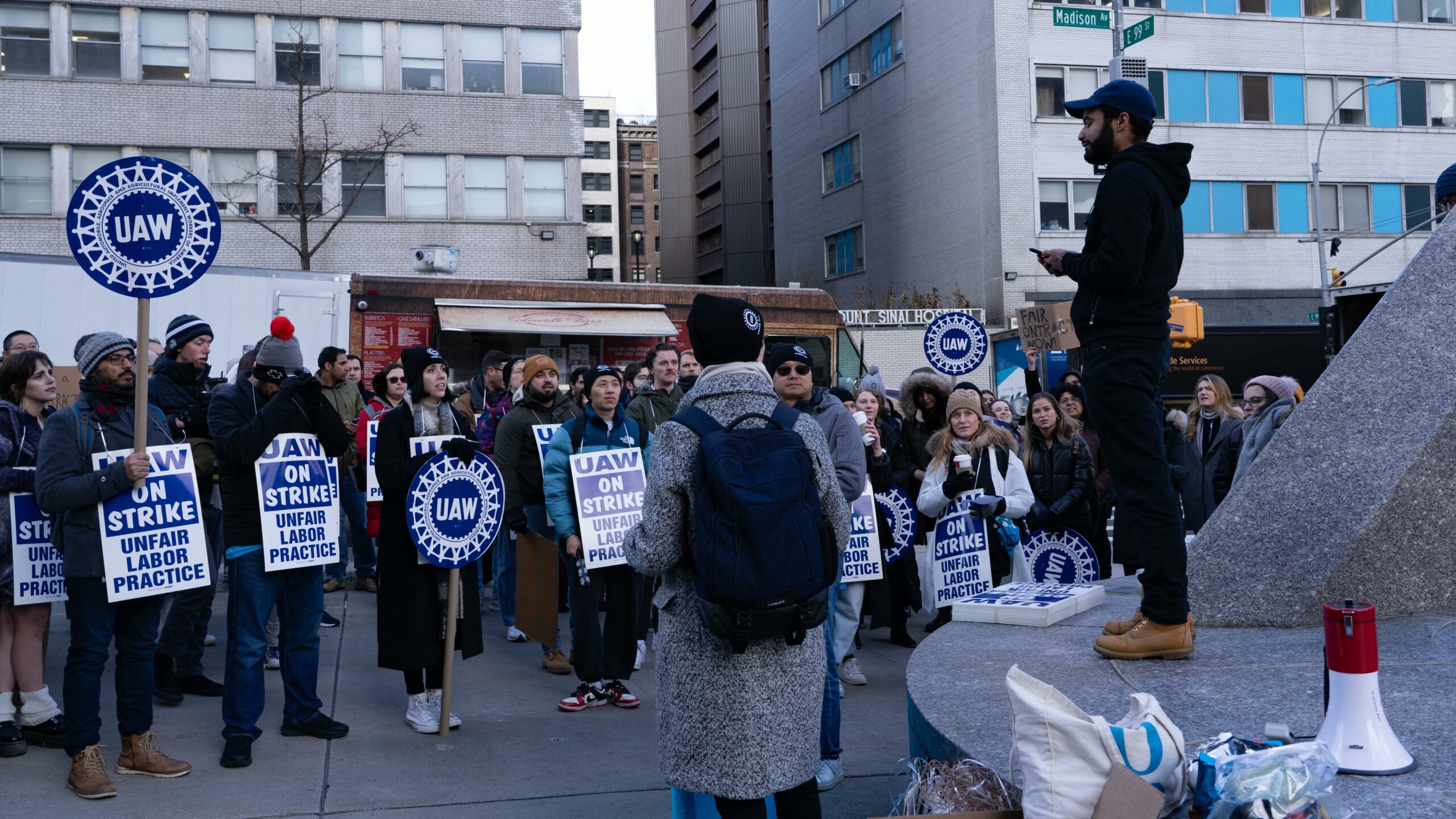
Over 100,000 academic employees across the U.S. have already chosen to join UAW. This includes graduate student workers at Columbia University, New York University, The New School, Harvard University, Worcester Polytechnic Institute, University of Southern California, Caltech, University of Connecticut, University of Massachusetts, University of California, and University of Washington, among others. In just the past year, researchers at University of Pennsylvania, Caltech, Princeton University, Albert Einstein Medical College, Weill Cornell Medicine, and most recently Rockefeller University have voted to join the UAW. By uniting together, academic employees are driving up standards in higher education and building a powerful voice for grad workers, postdocs, research scientists, and non-tenure track faculty.
In June 2022, Postdoctoral Fellows at Mount Sinai voted by an overwhelming 90% in favor of unionizing with UAW, despite significant efforts by Mount Sinai to convince them to vote “no”. They went on to negotiate a historic first contract, which they ratified by 98%, raising standards for postdocs across the US. We were proud to stand with Sinai postdocs in their contract campaign – their working conditions are our working conditions, and we share many of the same priorities as researchers. Together, we drive the vast majority of the research at Mount Sinai, and by forming our own union, we can more effectively coordinate in order to build a stronger voice for all of us working in labs at Sinai.
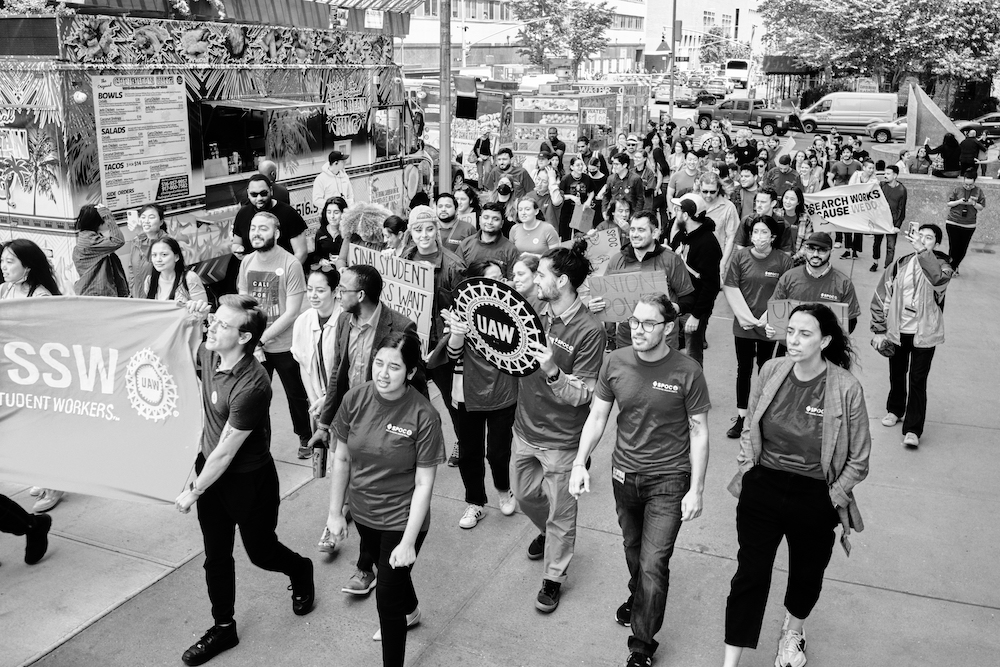
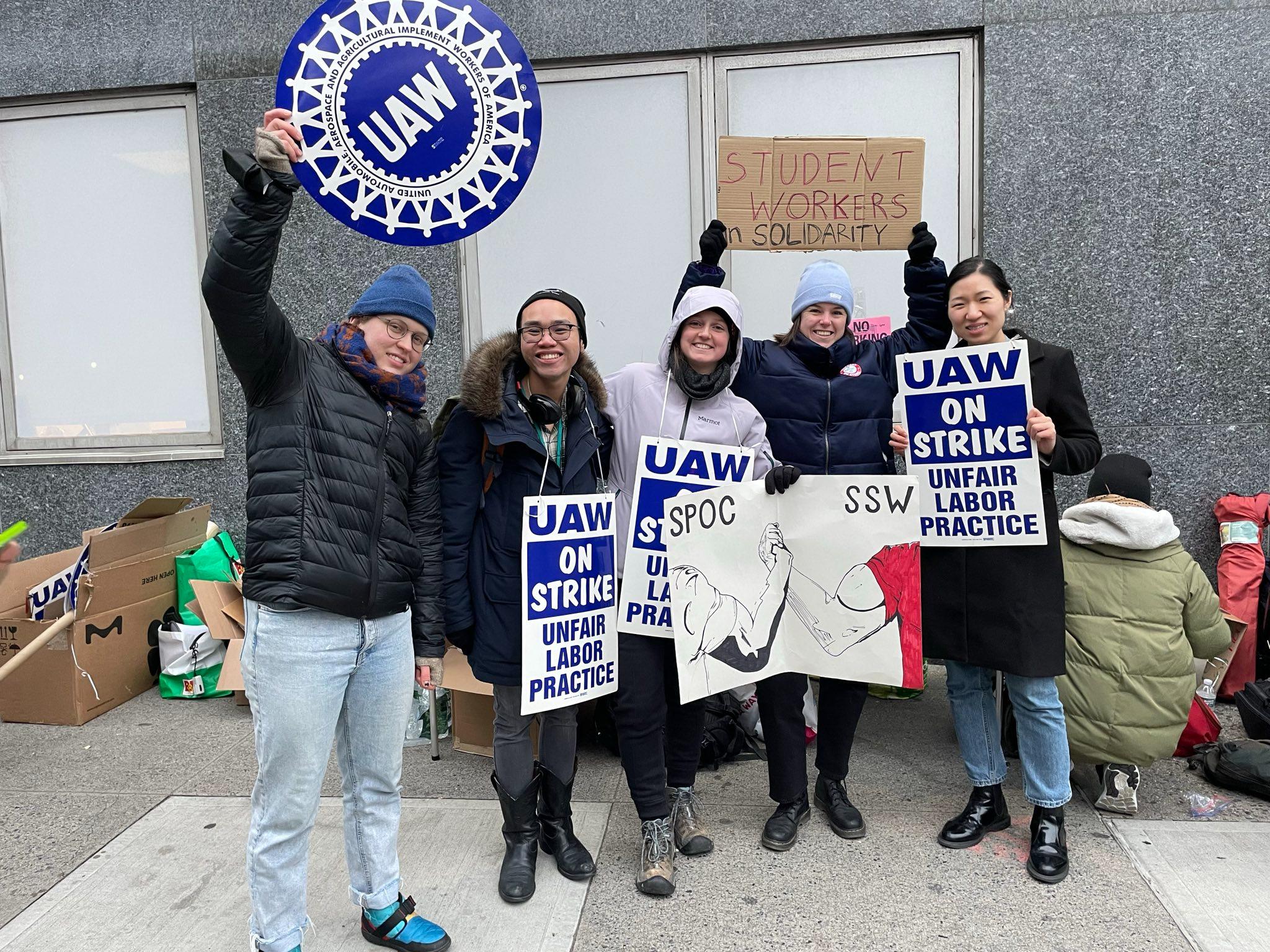
A Message from SPOC-UAW Members
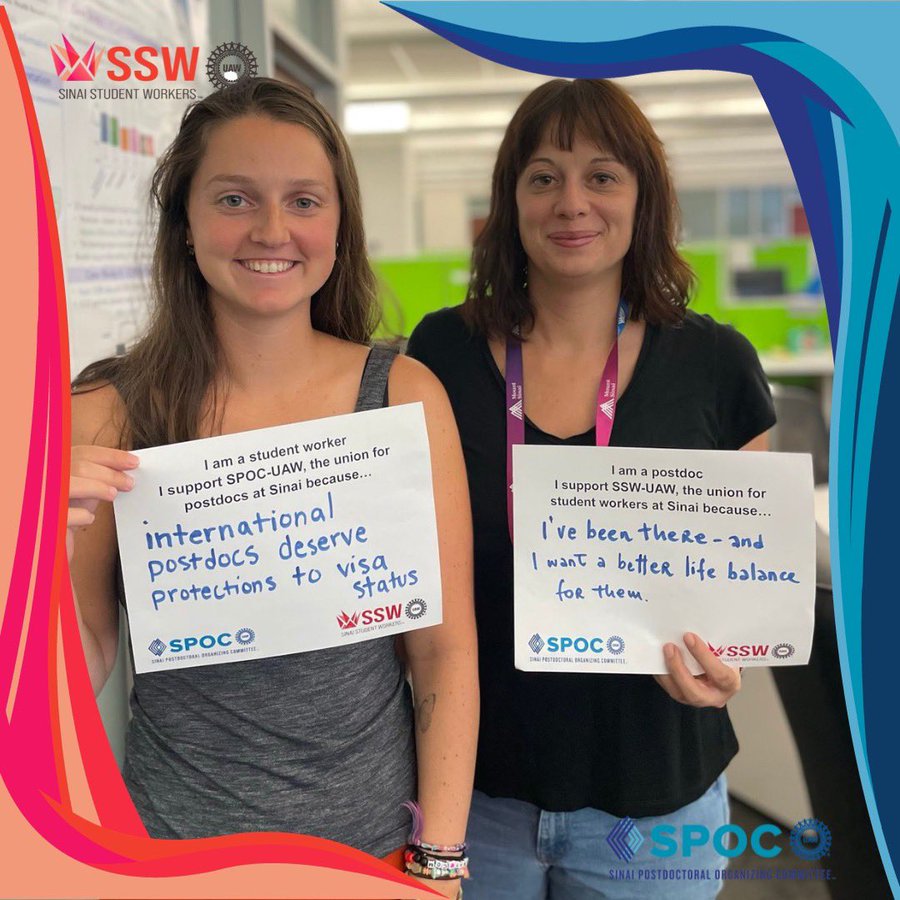
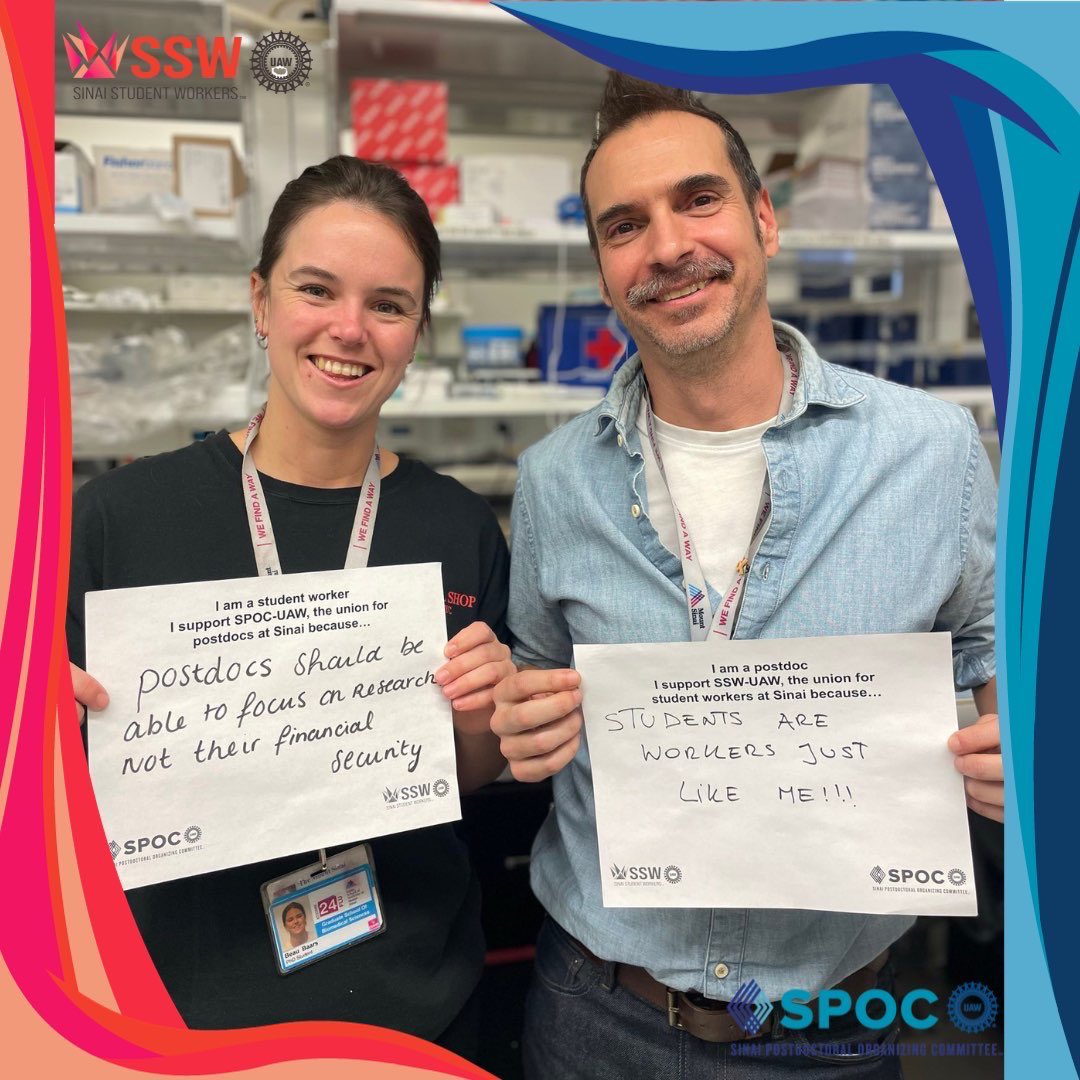
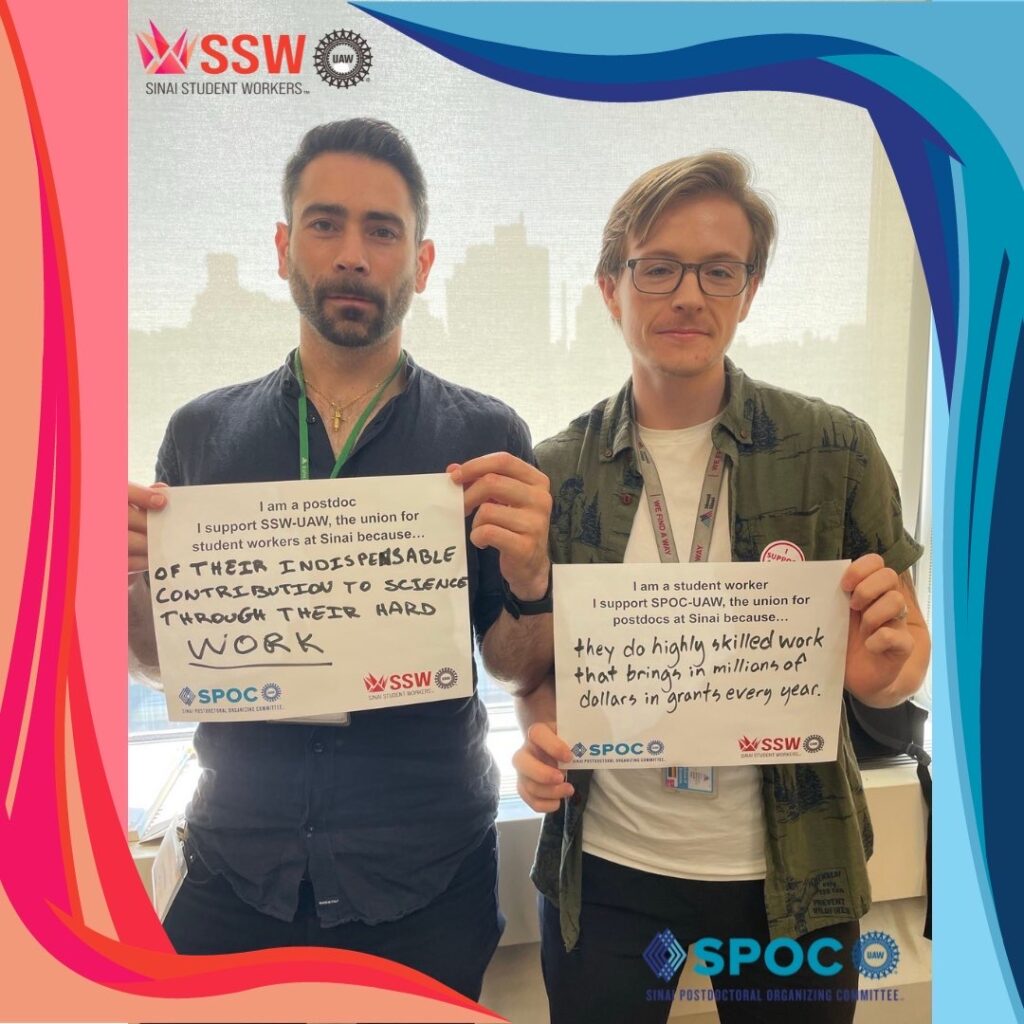
Together we can make Sinai more equitable and inclusive.
Inequalities — including those based on gender, race, sexual orientation and immigration status — continue to create barriers for many of the most talented to enter the academic and scientific workforce. And existing systems of recourse for problems like discrimination, harassment, and bullying too often fail and can take years. A recent survey conducted by Nature found that 1 in 5 grad students faced gender or racial-based discrimination, and another study found that early-career researchers from abroad are more likely to be threatened with termination.
Though much work remains to be done, graduate students, postdocs, and adjunct faculty in the UAW have helped make progress on many of these issues, both at the bargaining table and in policy advocacy through the UAW. At the University of Connecticut, for example, a graduate assistant worked with her union to successfully resolve a major sexual assault and harassment complaint in three months, whereas complaints of gender and race-based discrimination against Sinai leadership have remained unresolved years later. By forming a union, we can negotiate for strong, survivor-centered protections and hold Sinai accountable.
At other major research institutions like Columbia, NYU, the University of Washington, and WPI, graduate employee unions have won strong protections like enforceable timelines, union representation, protection from retaliation, and the option to appeal to a neutral third-party arbitrator for cases of harassment, discrimination, and abusive conduct. With a union, we have more power to be heard, to determine our right to a safe and healthy workplace, and to ensure that our rights are enforced.
Read More
Op-Ed: We’re Forming a Union to Create a More Equitable USC →
Inside Higher Ed: At Long Last: A Contract for Columbia Student Workers→
Elite Daily: UConn Graduate Student Union Helps Handle Sexual Harassment→
Medium: UC International Postdoc Takes on Pregnancy Discrimination and Wins→
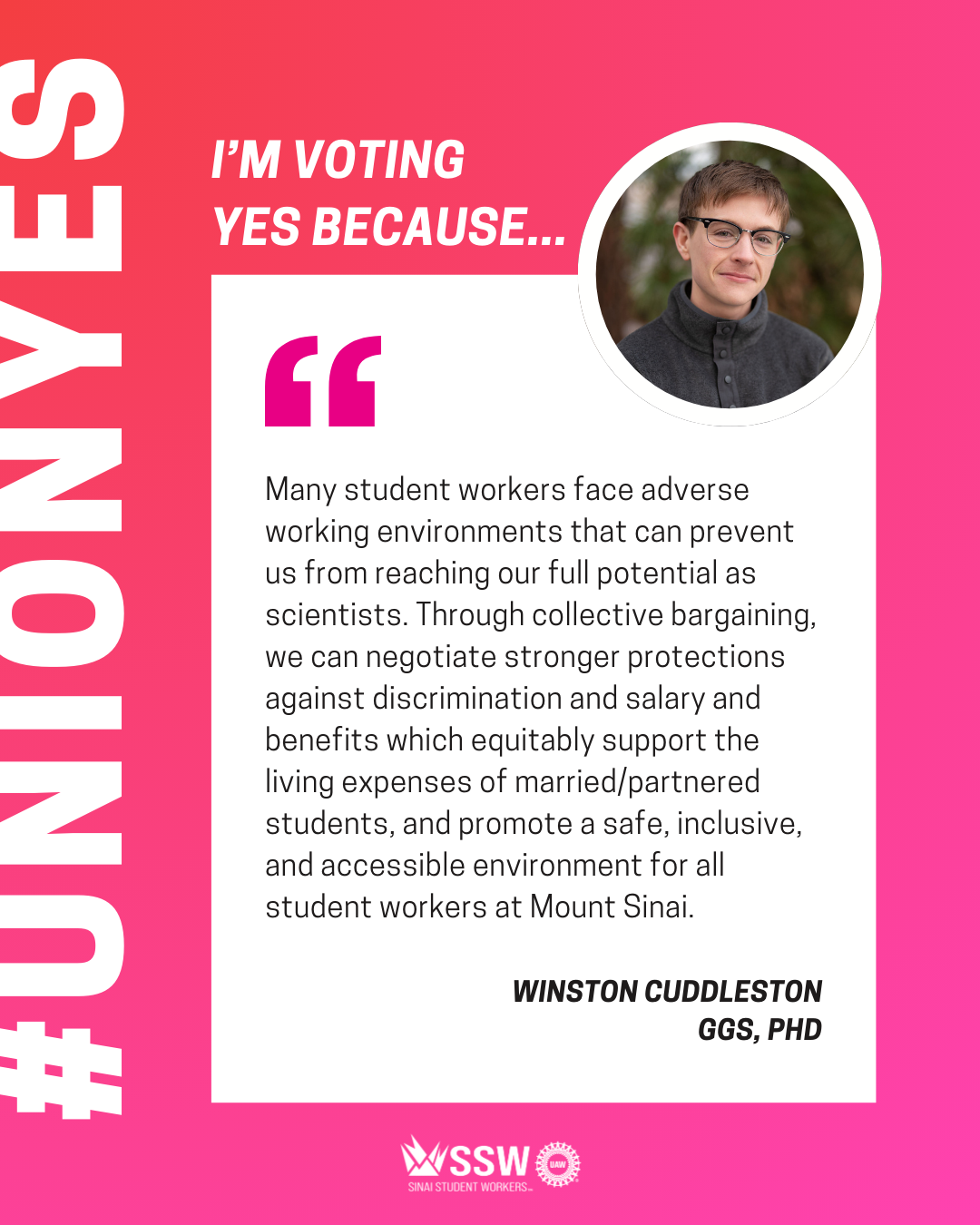
Fair workplace standards enable student workers to prioritize research.
As researchers, our work powers Sinai. Student Workers perform experiments, write research papers, TA classes, grade exams, contribute to patents, help write research grants, and more. Simply put, Sinai would not be considered a top-tier research institution without our work. We make these contributions in the most expensive city in the country, after years of historic inflation. And while Sinai has been forced to raise minimum salaries in order to remain competitive with other unionized institutions in NYC, these raises are neither guaranteed, nor protected, and are quickly falling behind other academic employers yet again.
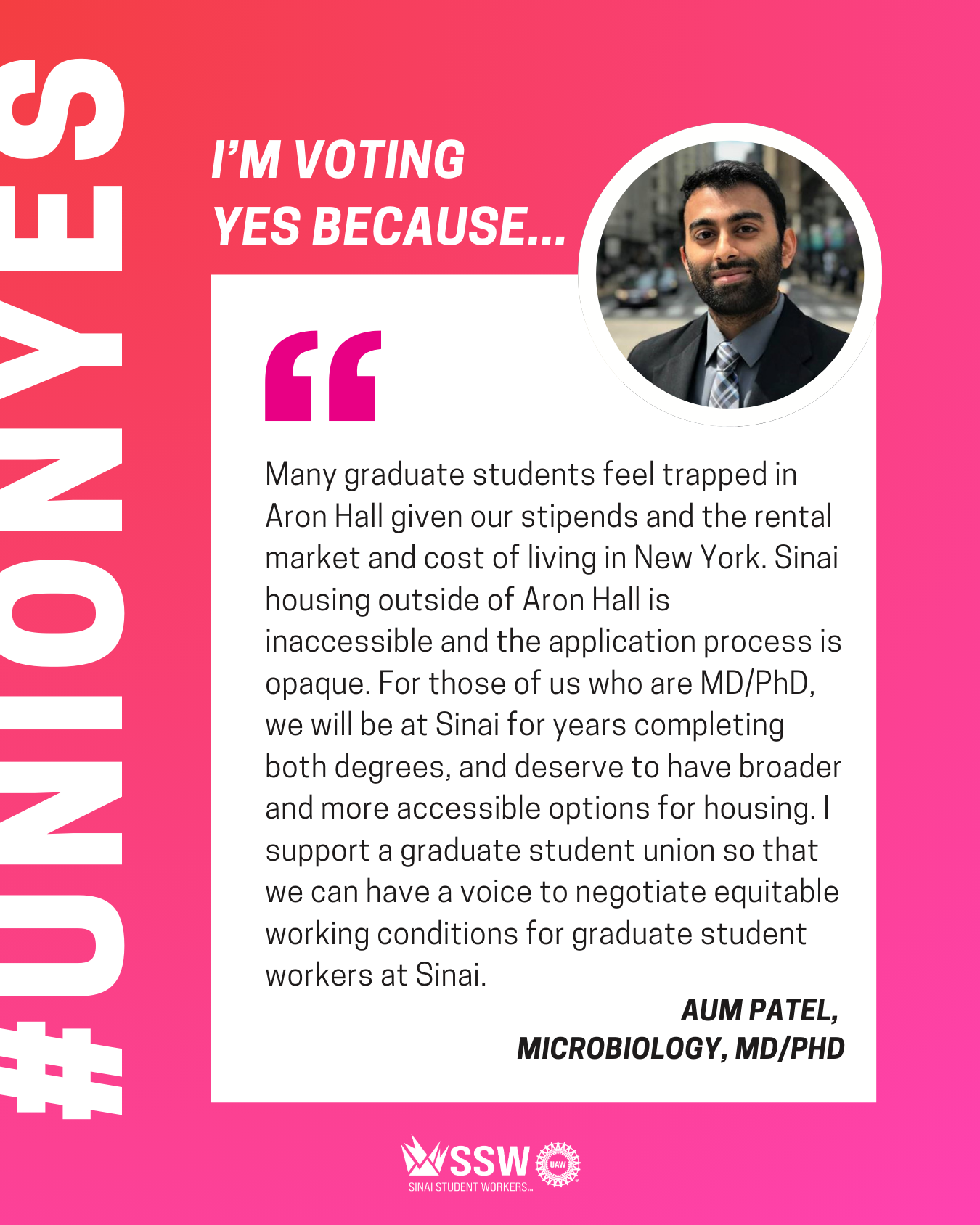
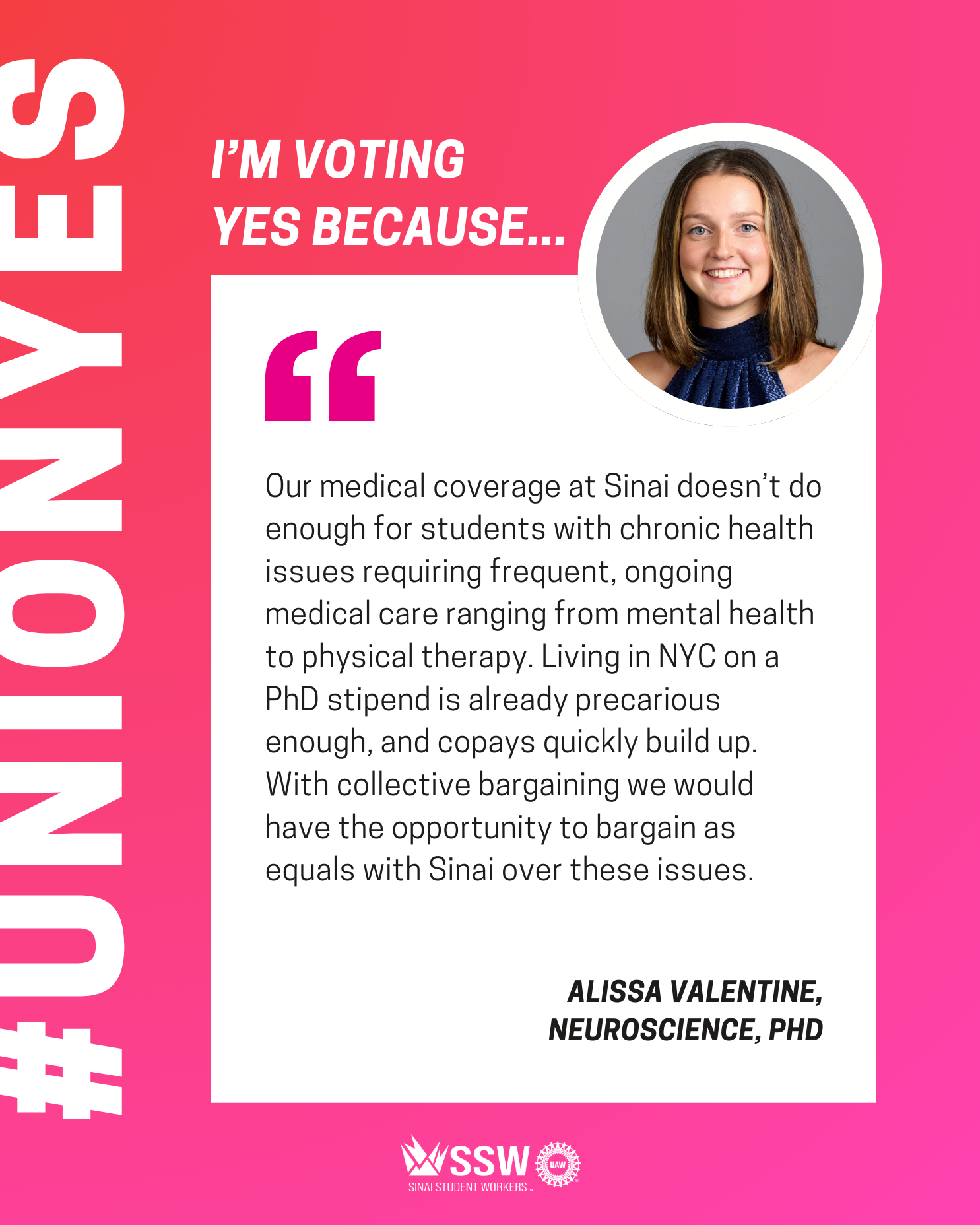
Just last year, our postdoc colleagues at Sinai approved their first union contract and took their minimum salaries from among the lowest for postdocs in New York City to the highest in the entire country. In doing so, they helped raise the standard for other NYC institutions while winning other important benefits for the first time, like paid parental leave, a fund for child care and housing-related costs, support for relocation, and paid time off for visa renewal. It is time for us to come together and demand pay and benefits that reflect the value of our contributions, and to secure them in a contract, so we can focus on the quality of our research instead of how to make ends meet.
Read More:
The Los Angeles Times: https://www.latimes.com/california/story/2023-01-02/uc-strike-energizes-labor-surge
People’s Policy Project: When Grad Students Unionize, Wages Go Up
Contract Before-and-After: How a Contract Improved the Sinai Postdoc Experience
A stronger voice for international student workers
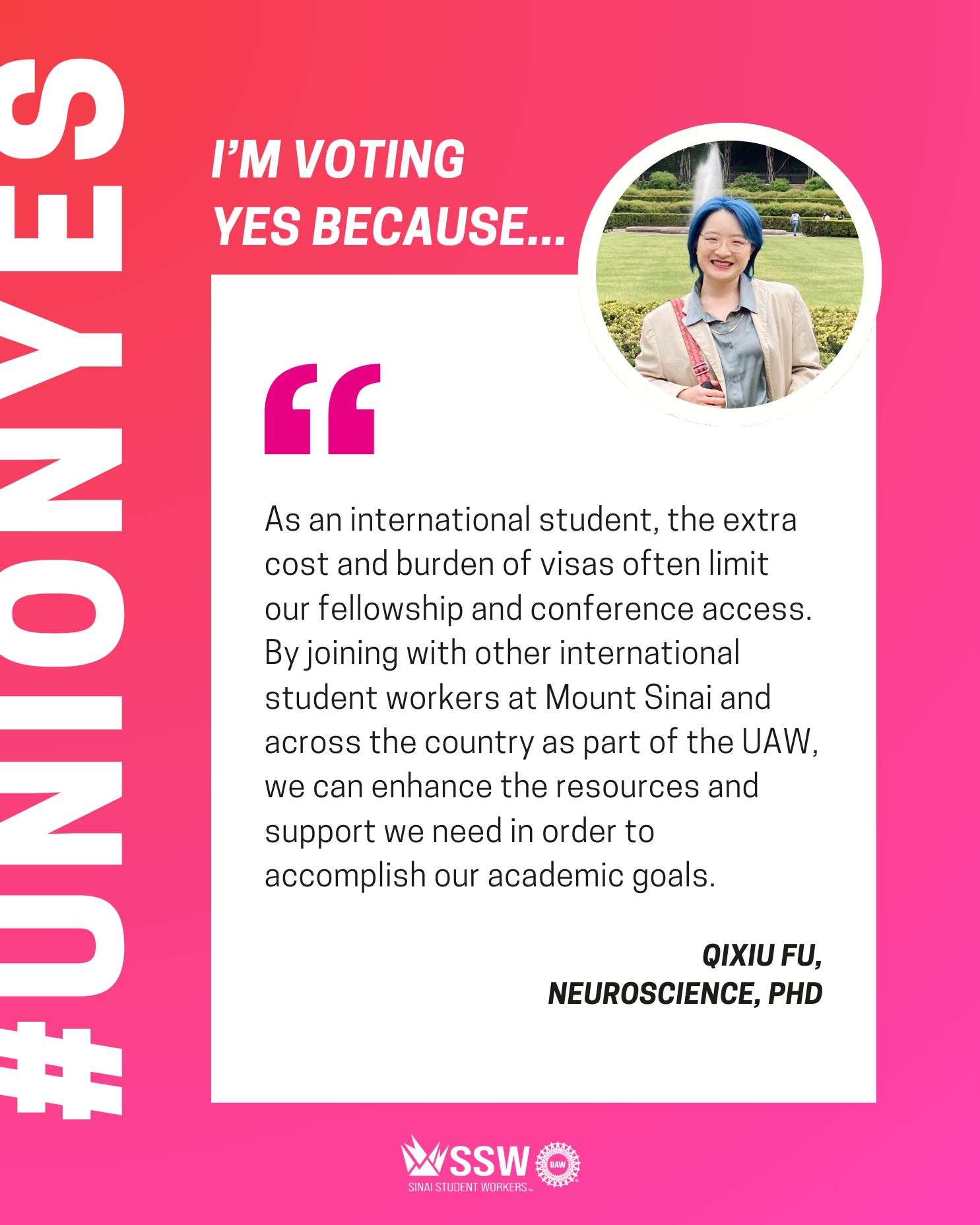
International student workers at Sinai living in the US on student visas make up a significant part of our community. International students can face multiple unique challenges. By unionizing we can negotiate for greater legal and structural support. We can also seek greater workplace protections – like protection from unfair termination, abusive conduct, and unreasonable work expectations – that are especially impactful for the international student community.
We can also create a community so we don’t have to face problems alone and gain a stronger voice at Sinai and in the national landscape. With more than 100,000 academic workers across the U.S., including graduate employees, postdocs, research scientists, and non-tenure track faculty, UAW nationally and locally has become a leading voice advocating for expanded opportunities for international students. By joining together, international grad student workers have a stronger voice to advocate for policies like increased access to OPT and opposing limits on international student visas.
The UAW’s commitment to international researchers and scholars stems from the leadership of international researchers and scholars themselves. Graduate employee and postdocs unions affiliated with UAW are often led by international scholars, who serve in top leadership positions in local unions nationwide.
Joining together with other academic workers in the UAW has become more urgent than ever as recent government actors have waged unprecedented attacks on science, sexual harassment protections, and the rights of international scholars.
READ MORE
International Student Rights: https://sinaistudentworkers.org/international-student-rights/
Op-Ed: Why International Grad Student Workers Support GSWOC-UAW →
UW Daily: UAW 4121 stands up against new Trump ruling that limits the visas of international students and scholars→
Columbia Spectator: UAW is a strong ally for international students and postdocs→
UAW 5810: Resolution To Mt. Sinai Postdocs on International Researcher Rights→
We are voting YES for our union, Sinai Student Workers-UAW (SSW-UAW)!
After hundreds of conversations among graduate student workers over many months, and despite Mount Sinai’s extensive efforts to stop our campaign, we will finally have the historic opportunity to vote “union yes” for Sinai Student Workers-UAW on September 26th. In doing so, we would join tens of thousands of unionized academic workers across the US who have already come together to improve their working conditions and create a more equitable, inclusive, and fair scientific community.
As student workers, we play a critical role in driving the world-class research conducted at Mount Sinai. However, without collective bargaining, we have no real way of contributing to decision making around our working conditions, which the Sinai administration decides unilaterally. Many of us struggle with the high cost of living in New York City, lack secure rights in the workplace, and face increasing uncertainty about our futures given the precarious nature of science funding and unstable regulation of visas and work authorization. This all unnecessarily hinders our ability to focus on quality research.
If a majority of us vote “yes” for SSW-UAW as our union, the Sinai administration would be legally obligated to bargain with student workers over salaries, benefits and workplace rights, and to commit any agreements into a binding contract.
We therefore urge our colleagues to vote ‘yes’ for SSW-UAW as our union, so that we have the strongest possible mandate to bargain a fair union contract with the Mount Sinai administration that improves our working conditions and our lives.
Adriana Mendez, Neuroscience
Alec Pankow, Microbiology
Alexa LaBanca, Neuroscience
Ally Magee, Neuroscience
Anupriya Ramamoorthy, Development, Regeneration and Stem Cells
Ariana Chriss, Genetics and Genomic Sciences
Ashley Cunningham, Neuroscience
Aubrey Houser, Development, Regeneration and Stem Cells
Austin Baggetta, Neuroscience
Axel Guzman-Solis, Microbiology
Bhavana Shewale, Development, Regeneration and Stem Cells
Charlotte Kearns, Microbiology
Shruti Venkat, Development, Regeneration and Stem Cells
Emma Hays, Neuroscience
Emma Andraka, Neuroscience
Erick Kim, Neuroscience
Erika Barrall, Microbiology
Estefania Valencia, Microbiology
Eva Bednarski, Microbiology
Foramben Patel, Immunobiology
Gabrielle Altman, Genetics and Genomic Sciences
Giselle Rojas, Neuroscience
Grace Jones, Development, Regeneration and Stem Cells
Grace Peppler, Development, Regeneration and Stem Cells
Anagha Menon, Development, Regeneration and Stem Cells
Yiyang Chen, Cancer Biology
Iden Sapse, Microbiology
Jeremy Fischer, Immunobiology
Jesse Mangold, Microbiology
Jira White, Development, Regeneration and Stem Cells
Justice Simonetti, Neuroscience
Kamryn du Plessis, Neuroscience
Levon Rodriguez, Disease Mechanisms and Therapeutics
Marianna Liang, Neuroscience
Marisa Goff, Microbiology
Mehek Ningoo, Immunobiology
Michelle Kim, Neuroscience
Mimi Zhang, Cancer Biology
Paula Restrepo, Genetics and Genomic Sciences
Philip Hwang, Neuroscience
Qi Xiu Fu, Neuroscience
Rasika Iyer, Neuroscience
Ratchell Sadovnik, Development, Regeneration and Stem Cells
Sam Mcconnell, Neuroscience
Sanan Venkatesh, Genetics and Genomic Sciences
Sanutha Shetty, Neuroscience
Soore Oguntuyo, Development, Regeneration and Stem Cells
Suzannah De Almeida, Neuroscience
Tesia Bobrowski, Microbiology
Trevor Murphy, Microbiology
Tri Dong, Neuroscience
Vishal Rao, Immunobiology
Yvonne Lin, Development, Regeneration and Stem Cells
Beau Baars, Cancer Biology