TL;DR:
- Please RSVP here for our next town hall on Thursday, April 4th at 6pm in East Meadow (rain date TBD) to discuss student rights and academic freedom.
- Sinai has removed an institutional policy that protected first amendment rights to free speech and assembly, without notice. Actions like these threaten the safety of everyone’s voice on campus, and demonstrate the importance of union protections.
- These actions happened around the same time that the administration sent out an alarming and misleading email that made accusations of discrimination and hate speech on campus (more details below).
- Once our union is recognized, Sinai will be legally required to bargain with us over any changes to our working conditions, and we can begin to fight for a contract that includes strong, legally enforceable protections.
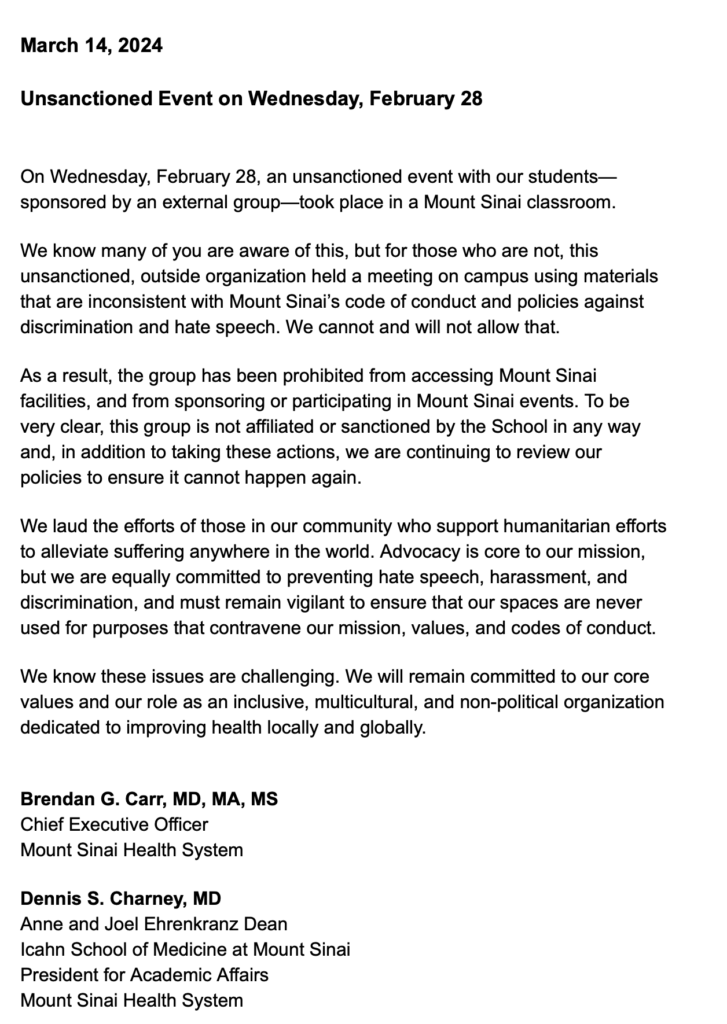
As you may be aware, last Wednesday, March 13th, Mount Sinai sent out an email about an “unsanctioned event” by an “outside organization” that involved “materials that are inconsistent with Mount Sinai’s code of conduct and policies against discrimination and hate speech”. The email also described Mount Sinai as a “non-political” organization. The email did not provide any further context or information about this event, creating an atmosphere of confusion and alarm.
The purpose of our email is to 1) clarify the facts of the event, 2) highlight that the administration has unilaterally revoked a policy that ensured rights to freedom of speech and assembly for the entire ISMMS community, and 3) emphasize how this situation illustrates our current vulnerability to institutional power, and demonstrates our need for union protections.
Clarifications about the event:
- The event in question was a peaceful, informational event about the on-going humanitarian crisis in Gaza in the context of healthcare provision, and was attended by over 100 people from across Sinai. The event also sought to build community for people affected by the on-going crisis.
- The event was organized entirely by Sinai students.
- Many students who attended the event did not see anything that would constitute hate speech or discrimination.
- Currently, the Sinai administration has the power to unilaterally define what does or does not constitute hate speech and discrimination, and can change these policies without notice at any time.
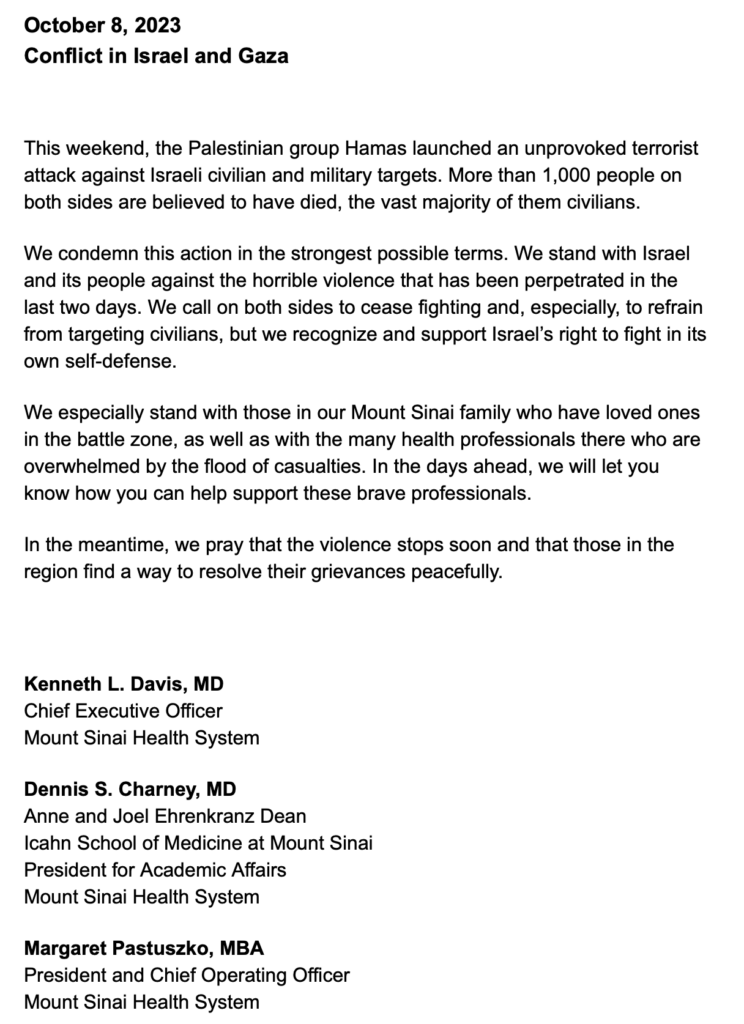
- Despite their claim to be a “non-political” organization, on October 8th, Mount Sinai sent an email via Broadcast Notifications titled “Conflict in Israel and Gaza” and stated “we recognize and support Israel’s right to fight in its own self-defense.” This is just one example of how Mount Sinai does take a stance on political matters.
Recently, Mount Sinai has made a number of changes to their code of conduct policies for the ISMMS community:
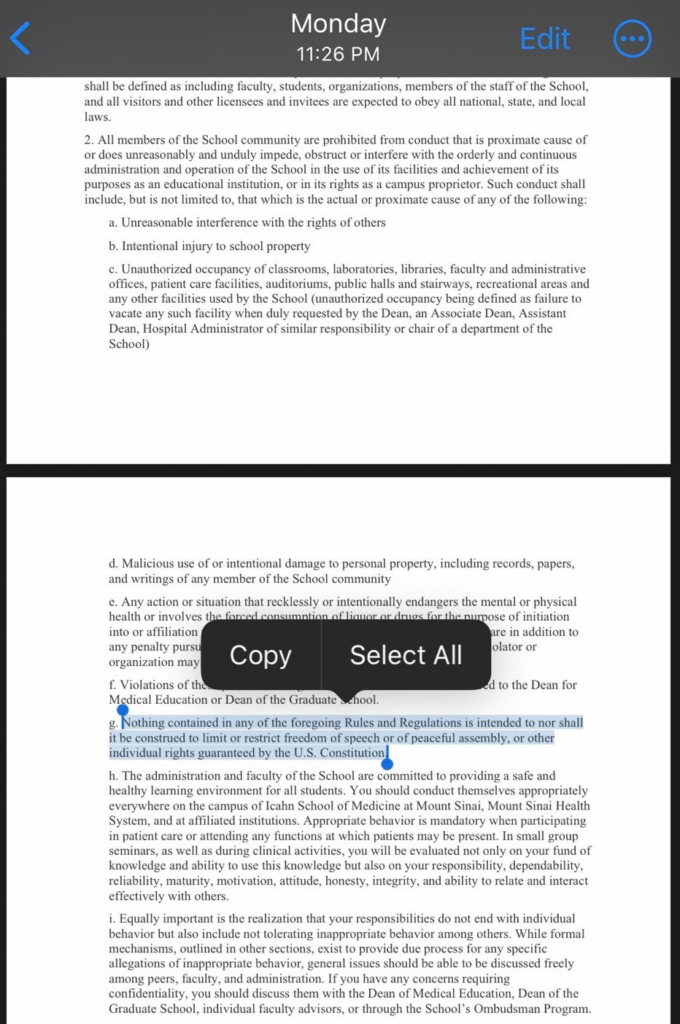
- Between Monday, March 11th (our last documentation of the policy – see attached screenshot #1), and Wednesday, March 13th (the day the email went out), Mount Sinai removed the “General Rules of Conduct Policy”, which applied to all ISMMS community members, from their “Student and Faculty Conduct” webpage. This policy contained the following:
- “Nothing contained in any of the foregoing Rules and Regulations is intended to nor shall it be construed to limit or restrict freedom of speech or of peaceful assembly, or other individual rights guaranteed by the U.S. Constitution.”
- Additionally, you can see for yourself via the Wayback Machine that the policy was still on the website as of January 5th, 2024 (the last time the Wayback Machine recorded the site).
- We have a downloaded copy of the 2021-2022 graduate student handbook (download here). It contains the section “Rules of Conduct,” which includes a similar statement to the (now removed) “General Rules of Conduct Policy,” stating that:
- “Nothing contained in the foregoing rules and regulations is intended nor shall it be construed to limit or restrict freedom of speech or peaceful assembly, or other individual rights guaranteed by the Constitution.”
- The phrase “hate speech” does not appear anywhere in the document.
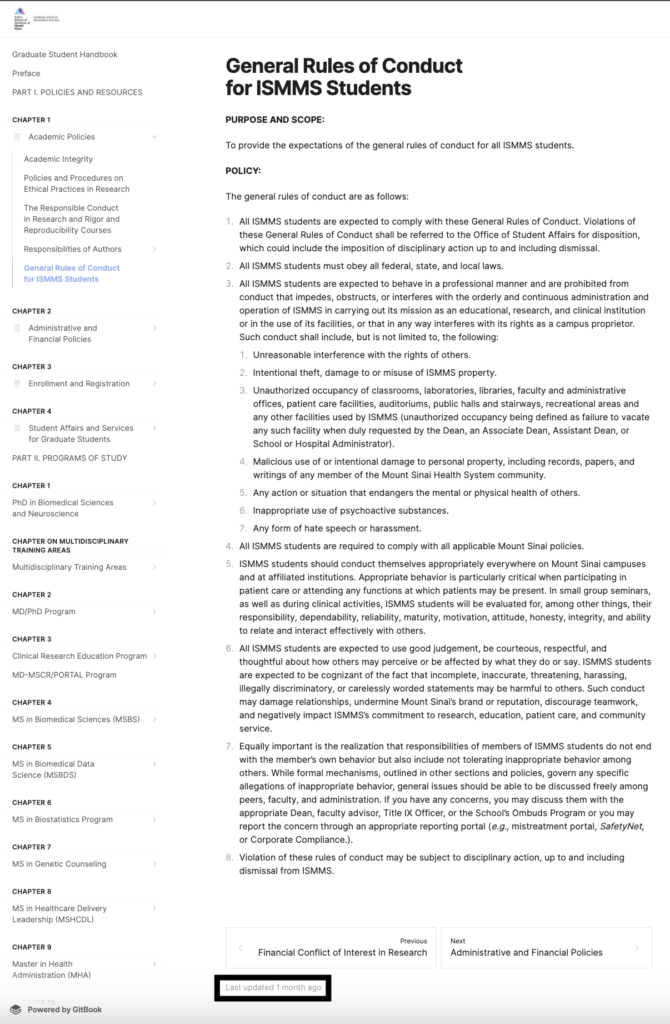
- Currently, the online graduate student handbook contains a new section titled “General Rules of Conduct for ISMMS Students”, prominently featured in Chapter 1, “Academic Policies.” It does not have any provisions protecting freedom of speech.
- The website does not give an exact date, but does say that the page was updated “one month ago” (highlighted in attached screenshot #2).
- It contains a statement about expectations to “behave in a professional manner” and prohibits “any form of hate speech or harassment.”
- Inconsistently, a different “Rules of Conduct” policy has not been updated for over a year in Chapter 4 of the handbook, and matches the version from the 2021-2022 handbook. It is unclear why this inconsistency exists, or which version Mount Sinai intends to enforce.
When it occurs, hate speech should not be tolerated. It is good that the “General Rules of Conduct for ISMMS Students” (now) reflects that. However, without clear definitions or procedures in place to address false or unsubstantiated accusations, this policy can be used as a weapon to silence historically marginalized voices. Mount Sinai currently has the power to unilaterally decide what does and does not constitute hate speech, and take disciplinary action on that basis without any kind of oversight from students or outside organizations. This is a dangerous situation, especially in combination with the fact that Mount Sinai is a private institution, and has revoked a policy protecting our right to free speech without notice. In the US, individuals on private property are not legally guaranteed rights to free expression and speech.
Clearly, Sinai has demonstrated that they can and will change institutional policies that affect us without consulting or even informing us. Once we are unionized, Sinai will be legally required to bargain with us over any changes to our rates of pay, wages, hours of employment, and other conditions of employment. In bargaining for a contract, we can have a voice in establishing workplace policies. Having these policies in a contract would prevent Sinai from being able to change them unilaterally, and make them legally enforceable.
However, because Sinai has refused to acknowledge that we are workers as well as students, our right to a union has been delayed for 7 months and counting while the National Labor Relations Board (NLRB) rules on our case.
This is egregious behavior on the part of Mount Sinai. We stand for the rights of all student workers, and will do everything in our power to protect those rights. If you have any questions, or if you have resources or ideas to offer, please let us know.
In Solidarity,
The Sinai Student Workers (SSW) Organizing Committee